
About Us
Totam rem aperiam, eaque ipsa quae ab illo inventore veritatis et quasi architecto beatae vitae dicta sunt explicabo. Nemo enim ipsam voluptatem quia voluptas sit aspernatur aut odit aut fugit, sed quia consequuntur.

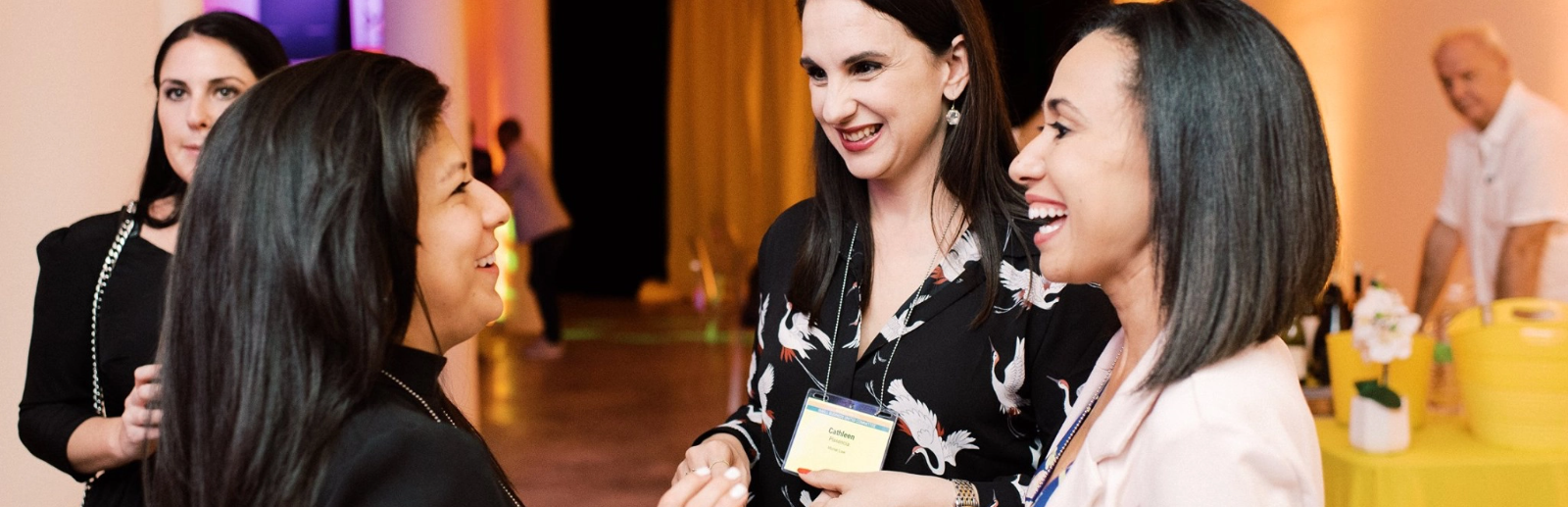
Celebrating its 25th year, VeritageMiami brings together a who’s who of more than 2,000 wine, beer and food lovers for a world-class gathering with top sommeliers, notable chefs, prestigious wineries and breweries and an impressive lineup of auction lots all to benefit the South Florida community. VeritageMiami benefits United Way of Miami-Dade, supporting programs in our community that are focused on improving the education, financial stability and health of our residents. VeritageMiami is part of Veritage, a series of celebrations of wine, food and philanthropy.
Since 1924, United Way of Miami-Dade has been an innovative force in the community, successfully responding to emerging needs and transforming people’s lives. Today our work is focused on education, financial stability and health – essential for quality of life. We invest in quality programs, advocate for better policies, engage people in the community and generate resources. It is through our work in education, financial stability and health that we effect change — transforming vulnerability into empowerment, poverty into opportunity and despair into hope. VeritageMiami Phone: 305.646.7105 Email: info@veritagemiami.com

Our 25-Year History
1996
1998
1999
2003
2004
2004
2007
2010
2013
2014
2015
2017
A Festival Begins with an Auction
Written by VeritageMiami Director Lyn Farmer
This is the 25th anniversary year of VeritageMiami – a quarter century of sharing great wines for a great cause, helping our fellow citizens here in South Florida. Anniversaries are equally about reflecting on the past as they are about looking forward and with that in mind, we’ve started this new page on the VeritageMiami website to share our history with you. During these cloistered times, I thought a bit of sunny reflection would help lift the pandemic gloom, so here we go, creating a timeline that over the next 10 weeks will share the sometimes-convoluted path that moved this event forward over two and a half decades. It’s been a lot of wine in the glass, that’s for sure, and therein lies a story.
South Florida has been a center for wine collectors for decades and there were always tastings and opportunities for these enthusiasts to get together. One of the most important of these was an annual gathering on Miami Beach, driven mainly by wine distributors. This event, the Annual South Florida International Wine & Food Festival, was staged for several years at the Doral Beach Ocean Resort on Miami Beach, and usually took place during the workweek. In 1995, several prominent wine collectors and people in the wine trade began talking about giving the trade-oriented event a charitable component. Led by Mike Bittel, an influential South Florida wine retailer and community activist, and Dr. Sergio González-Arias, a leading physician at Baptist Hospital, among others, the group decided to stage an auction to benefit Baptist Hospital of Miami Foundation and United Way of Dade County, as the charities were then known.
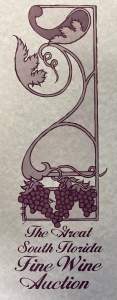 This event, dubbed The Great South Florida Fine Wine Auction, was tacked on to the Miami Beach festival, extending the beach event into Saturday for a fourth day: January 27, 1996. I was the emcee of that first wine auction, and I can confirm that, in offering 150 lots of highly sought-after luxury goods, travel and special wines from leading wine collectors and great vintners around the world, the event was a stunning success. The auction tallied bids of more than $180,000 and the entire event, including sponsorships, netted $210,000 for the two charities. More importantly, it laid the groundwork for another auction the following year.
However, when it came time to plan a follow-up event, the organizers wanted to move from Miami Beach to the mainland where more of the charities’ patrons were situated. The venue with the largest and most conducive event space in downtown Miami was the Hotel Inter-Continental, so planning began for a food and wine extravaganza that would set the auction within a gala dinner featuring an array of top South Florida chefs – in essence, a culinary event to draw additional people to the wine-focused auction.
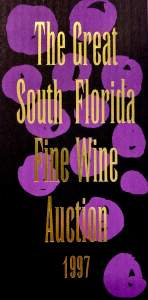 Thus, the second annual Great South Florida Fine Wine Auction was held a year after the first, on February 15, 1997 and with it, the organizers were already creating auction lots that would set a pattern for future events. Travel and luxury products balanced the heavy emphasis on wine, and often produced some hybrid lots, like a business-class trip for two to Paris packaged with a fast train to Bordeaux, several nights at an influential château (in this case, Château Pavie) and tastings throughout the region. That lot brought in $6,500, while a collection of three 6-liter bottles of Château Léoville Las Cases from vintages 1982, 1986 and 1989 sold for $8,500. With the final hammer of the gavel, the one-night auction brought in another $210,000 for the two charities. Clearly, a high bar was being set!
Some elements familiar to today’s festival goers were already in place in this auction in addition to lucrative lots for bid, including a Champagne reception (this one featuring Perrier-Jouët), and a gala dinner featuring five top local chefs (including Michael Schwartz, then at Nemo, who will make his fourth festival appearance in Spring, 2021 at the Farm to Fork Brunch). Just as importantly, it set the scene for a number of elements to coalesce not just into another wonderful auction dinner, but a full-blown, weekend-long wine, food and lifestyle festival. Perhaps most interesting of all from a historical perspective, they didn’t wait until the following year to create the festival but staged it just two months later, including yet another auction.
Next week we’ll explore how the wine festival we know today sprang from an auction and found a new home at a historic landmark, with the Great South Florida Wine Auction inspiring The Biltmore International Wine Festival at Coral Gables over three days in April, 1997.
Cheers!
The Festival Comes Together
We started tracing the history of what today is called VeritageMiami with the introduction of two auctions in 1996 and 1997, both called The Great South Florida Fine Wine Auction. Both years, the event included a dinner with some top chefs but that was the extent of the event – a single evening with an auction featuring wine, travel and lifestyle lots, and coincidentally, both years the auction brought in about $210,000.
Even as the second auction was in its planning stages, another player was talking about bringing a wine event to the area. The historic Biltmore Hotel in Coral Gables was constructed in South Florida’s first land boom in the 1920 and, modeled after the Alhambra in Spain, became an icon of what was called Mediterranean Revival architecture. The Biltmore had gone through several ups and downs and by the early 1990s was looking to reestablish itself as a glitzy, upscale destination and one way to do that was with wine and food, leading to the creation of The Cellar Club.
In a bit of behind-the-scenes trivia, let me digress and point out that from the early 1980s until 2009, one of the country’s most admired wine magazines, The Wine News, was published in South Florida. It had international visibility and for 20 years, I was a senior editor for the magazine, reviewing wines, writing a column for every issue and one or two cover stories every year. The Wine News had its editorial offices for a time at The Biltmore Hotel in the mid-1990s and its presence there spurred the hotel’s decision to cement its reputation as a beacon for wine lovers in South Florida by creating the wine club and wine bar in 1995.
So, back to the Great South Florida Fine Wine Auction. The two benefiting charities wanted to raise the event’s visibility and net income. Many of the auction’s leading volunteers, including most South Florida wine collectors, were also members of The Cellar Club and over numerous glasses (well, probably bottles) of wine, two needs coalesced: the charities’ wish for a higher profile event and the Biltmore’s wish to increase its presence as a fine wine destination. The result was the inception of a full weekend of events that would encompass an auction as well as cooking demonstrations, dinners and wine. Thus, two months after the second Great South Florida Fine Wine Auction in February 1997, The Biltmore Hotel and The Wine News magazine staged what was essentially a trial run of a new festival in April 1997 and wine lovers in the area felt they’d struck the vinous mother lode.

1997 Biltmore International Wine Festival program cover and auction painting (Credit: Jesus Fuertes)
This new event, The Biltmore International Wine Festival at Coral Gables, reflected the hotel’s determination to maintain control over the program. Altogether, the festival raised more than $100,000 for United Way of Dade County (Baptist/South Miami Hospital did not participate in this trial run). Over the next few months, United Way of Dade County, Baptist/South Miami Hospital Foundation and the Biltmore/Cellar Club teams pooled ideas. By autumn 1997 it was official: The Great South Florida Fine Wine Auction would join forces with The Biltmore International Wine Festival and what had originally been seen as a fairly local event had big plans on the horizon.
Looking back, we have generally considered the 1997 Biltmore festival as our beginning and the one from which we count our 25 years, but it was the second Biltmore International Wine Festival in 1998 that first presented a true and lasting concept to the public. All the elements that marked our festival going forward are there, plus a few that have been amended or dropped along the way.

1998 Biltmore International Wine Festival program cover and auction painting (Credit: Jesus Fuertes)
The 1998 weekend began with a Friday golf tournament followed by a winemaker lunch, a Bordeaux wine seminar and then the important wine tasting that was a signature event for many years. Fifty wineries and 12 South Florida restaurants participated creating an enormous amount of local support and enthusiasm for the festival. This, more than any of the more formal events, had the feeling of a “festival.”
On Saturday at noon, local star chef Norman Van Aken, one of the pioneering “Mango Gang” of South Florida chefs attracting national attention, offered lunch with a twist: he was on stage, and each table of 10 guests had its own cooktop to make the three-course lunch along with the chef. This was originally conceived as a fun way to add a twist to the festival, but over the next couple of years, this “interactive cooking experience” became the signature component of the entire festival.
Saturday night, the Great South Florida Fine Wine Auction and Gala Winemaker Dinner (we had a penchant for convoluted names in those days) was held with Napa Valley and Sotheby’s auctioneer Fritz Hatton on stage. Fritz is a musician, a winemaker and one of the country’s greatest wine auctioneers and he quickly became a regular for the next several years. With his urging the 600 attendees drove the bidding to more than $360,000, immediately place the auction among the top 10 charity wine auctions in the country.
The next morning, the weekend wrapped up with a Champagne brunch after which the now combined third annual Great South Florida Wine Auction and second annual Biltmore International Wine Festival netted more than $500,000. It was a stellar event on many levels: the net to the charities was significant and it brought together several segments of the community in an invigorated vision of how wine and food could drive civic and charitable involvement. And of course, that involvement continues to this day with the 2021 VeritageMiami happening as a hybrid IRL (in real life) + virtual combination.
Building a Bigger Festival
Shortly after the 1998 wine festival weekend concluded, an official announcement was made that The Biltmore International Wine Festival and the Great South Florida Fine Wine Auction had officially merged and would now be known as The Biltmore Great South Florida Wine Festival. Thank goodness – no more juggling names!
The Biltmore, United Way of Miami-Dade (as the charity was now called) and Baptist/South Miami Hospital Foundation took a great deal of pride in noting that, having brought in over $500,000 during the 1998 festival, the “new” event was the largest and most successful three-day charity wine and food event in Florida. Other festivals were appearing on the horizon but this event at The Biltmore was clearly the trailblazer and we wasted no time in announcing great plans for 1999. The newly retitled festival was scheduled for April 16 – 18, 1999: the weekend opened with a golf tournament, and the grand tasting on Friday night would be even grander with more than 250 wines from 50 wineries from around the world available for tasting and matching up with food from 15 of South Florida’s top restaurants.
From its beginning, the festival linked wine and food and in 1999 the chef lineup was brilliant: after Friday’s tasting, the Saturday auction dinner featured three Michelin-starred chefs from France so that, while the festival’s main source of income for the charities was the wine-centric auction, food lovers had plenty to revel in amid the Biltmore’s luxurious setting. The auction drew out major collectors from across South Florida for more than 96 live lots (so it was a long evening!) plus 163 silent auction lots.
In hindsight, what I find most notable in the 1999 festival is how far forward we managed to carry the interactive cooking component pioneered the year before. This is today such an integral part of the festival it’s hard to recall just how innovative the concept was at the time: world-class chefs not giving cooking demonstrations, but collaboratively leading guests in cooking with them. All three French chefs that headlined the night before were on hand for the Sunday lunch, each preparing one course on the stage, with a cooking station at every guest table so patrons could prepare the meal step by step with the chefs. Every table also had a winemaker or winery representative on hand as well to coordinate wine pairings with the meal. This chef-guest collaboration has continued every year since.
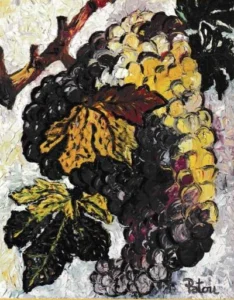
2000 Biltmore Great South Florida Wine Festival program presented by Merrill Lynch (Credit: Patou)
With the new millennium the following year, there were many signs of the festival’s growth. Some were subtle “back of the house” changes, like introducing multiple books at the 2000 Biltmore Great South Florida Wine Festival – separate catalogs for each event to stress the diversity (and size) of the festival’s offering. Others were more visible, such as nearly doubling the number of restaurants at the Grand Wine & Food Tasting on Friday night – there were still around 50 wineries (each pouring four to seven wines) but now 23 restaurants attended, further stressing the importance of being a wine and food festival.
Perhaps the most visible change in 2000 was expanding the offerings to guests on Saturday night. Once again, the inimitable Fritz Hatton was on stage to spark bidding on the 80 live auction lots, including some stunners for wine collectors such as a 10-vintage vertical of ultra-rare Penfolds Grange shiraz and a private dinner with local celebrity chef Norman Van Aken that included a total of 35 wines from the legendary 1985 vintage (remember, this was in 2000 so these wines were very much on everyone’s radar). Recognizing that such a large auction dominated the evening and wasn’t of equal interest to all the attendees supporting the charities, in 2000 we introduced a second event for Saturday. Across the Biltmore courtyard from the grand auction dinner, an equally grand dinner dance featured South Florida’s premier swing band of the time, Jump ‘n Jive, providing the entertainment in lieu of the auction. Both dinners were prepared by another trio of Michelin-starred chefs visiting from France, who then were also featured in Sunday’s interactive lunch. It was all a stunning success.
By 2001, The Biltmore Great South Florida Wine Festival was attracting nationwide attention with mentions in influential wine magazines and a consequent effort to hold a place in the limelight. This year, Wine Spectator magazine joined as a co-presenter, but The Wine News dropped out when Wine Spectator demanded exclusive media rights to the event. Aiming for a broader reach of the festival, we increased the size of the Friday evening Grand Wine & Food Tasting to include more than 75 wineries (pairing with food from 21 South Florida restaurants).
Since so many of the auction lots at the dinner involved European wines, we also welcomed one of the leading figures of the Bordeaux wine trade to be our festival honoree, Madame May-Eliane de Lencquesaing of Château Pichon Comtesse de Lalande. With a French honoree, we then broke with the tradition of the past two years of featuring French chefs at the Saturday and Sunday events and focused instead on highlighting some of the most innovative talent in the U.S. including chefs Todd English of Boston’s Olives, Robert Curry of Domaine Chandon in Napa, Don Pintabona of New York’s Tribeca Grill and Mark Miller of Santa Fe’s Coyote Café alongside some top local chefs.
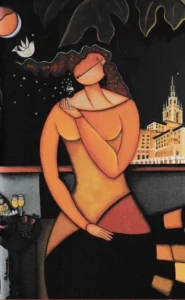
2002 Biltmore Great South Florida Wine Festival’s Grand Wine & Food Tasting presented by Diageo and in cooperation with Wine Spectator (Credit: Gilda Sacasas)
This proved to be a winning formula, achieving a great balance of international wines and national culinary stars propelling a series of events that successfully raised more than $500,000 for the two charities. The following year, 2002, brought in the global wine and spirits conglomerate Diageo as the presenting sponsor and welcomed an even larger group of importers and distributors than past events and featured the founder of Stag’s Leap Wine Cellars, Warren Winiarski, as the festival honoree. Another group of stellar chefs were invited to participate, including Rocco DiSpirito of Union Pacific in New York, Dean Fearing of The Mansion on Turtle Creek in Dallas, Wayne Nish of March in New York, and the late Charlie Trotter of the eponymous Chicago restaurant.
With another successful festival and record donations for the charities, The Biltmore Great South Florida Wine Festival was a powerful force on the local wine scene, but it was no longer alone. South Florida’s largest distributor, Southern Wine & Spirits, while still working with the festival, was starting its own annual event exclusively for the wineries it represented. At the same time, there was a debate raging within the Biltmore festival about what direction to take going forward. Changes were in the offing, and we’ll explore those next time, so stay tuned.
Cheers!
Onward and Outward
By 2003, now in its eighth year*, The Biltmore International Wine Festival was bursting at its seams. There were so many lots at the live auction we needed two auctioneers (Fritz Hatton and Ursula Hermacinski) to handle them, and the festival featured another extensive lineup of top local and national chefs. While the auctions brought in donations, the chefs brought in people.
The 2003 festival again was a balancing act between outstanding local chefs and national culinary stars, featuring top New York chefs Jonathan Waxman and David Burke and leading locals Cindy Hutson (Ortanique), Michelle Bernstein (Azul), Pascal Oudin (Pascal’s on Ponce), Robbin Haas (Chispa). Both Cindy and Michelle were making their first appearance at the festival but returned several times in future years.
Once again, there was the split between the dinner dance and the auction, which was the largest yet (my favorite lot was a huge horizontal tasting – 43 different Bordeaux classified growths from the stellar 1982 vintage including all the first and second growths). Between the auction and the dinner dance more than 600 people attended the Saturday evening event, and this highlighted a point of contention among the partners: Baptist Health South Florida Foundation and United Way of Miami-Dade wanted as many people as possible to attend because that pushed the yields from sponsorships, ticket sales and auctions higher, but The Biltmore was keenly aware that they had limited space in which to stage an event as elegant as they wanted for their image. They wanted to cap the Saturday event(s) at 400 and the charities wanted more (in 2019, before COVID-19 changed everything, the Interactive Dinner and auction on Friday night had more than 720 attendees).
This was a classic case of an irresistible force meeting an immovable object and the result was a split, with the charities taking the festival to a new venue in 2004, the Hotel InterContinental in downtown Miami, while The Biltmore continued to do single-night food and wine events independently on a more intimate scale. The 2004 event, now retitled the Miami Wine & Food Festival, may have looked a little different on the outside but the basics that had been so successful were still very much on show, albeit over two days instead of three.
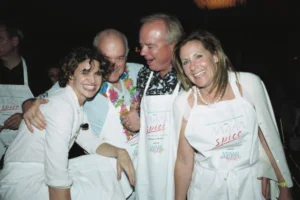
Michelle Bernstein’s encore at the 2004 Interactive Dinner held at Hotel InterContinental
Friday evening again featured a huge wine tasting but now instead of having an interactive lunch on Sunday, we expanded the Friday event and created an Interactive Dinner, an event that quickly became a festival signature and the most coveted ticket for the weekend. Michelle Bernstein came back for an encore, joined by Douglas Rodriguez of Ola, and Didier Virot from Restaurant Aix in New York. It was a big shift moving from a lunch preparation to a dinner and it succeeded in large part through a huge effort by the InterContinental’s executive chef Alex Feher who with his team managed the dinner for years to come.
Saturday we staged the traditional auction dinner with another crew of great local chefs including Tim Andriola of Timo and Willis Loughhead from The Ritz-Carlton Coconut Grove joined by David Bouley from New York. The move was a huge success and set the stage for a partnership with the Hotel InterContinental that with only a couple of detours continues to this day.
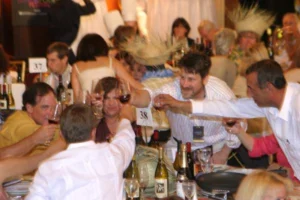
Guests at the 2004 Interactive Dinner
One thing we discovered in 2004 was a need to rethink how events fitted together. While the Interactive Dinner was a fantastic event, there were many people who only wanted to do the wine tasting especially younger consumers looking for a more reasonably priced wine option. With this in mind in 2005, we separated the two events and staged the wine tasting, now called “Taste and Toast” with dozens of wineries and a bevy of local restaurants participating, on Thursday night as a stand-alone event, though it was still at the InterContinental.
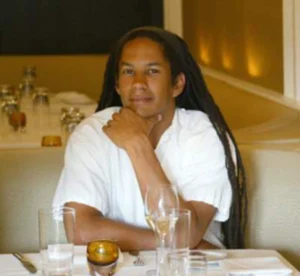
Chef Govind Armstrong, then of Los Angeles restaurant Table 8 and our celebrity chef in 2005
Friday the Interactive Dinner returned in the evening with a single guest chef. Rising star Govind Armstrong had made a name for himself on the Food Network, which was a growing influence on the chef culture in the U.S. (and would go on to compete on Iron Chef America). The audience loved having a single chef carry through three courses before the hotel kitchen did a dessert created by Armstrong and this set a formula we followed for many years of a single celebrity chef in the spotlight.
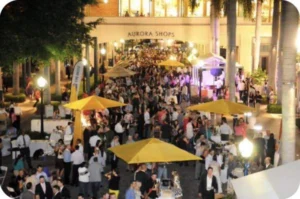
2005 Taste & Toast at Merrick Park
The Festival wasted no time in creating a splash, and staged Thursday’s wine tasting out of doors. After all, the event was held every year in March or April which is still cold up north but balmy and breezy in South Florida. Setting up the outdoor tasting at the large Merrick Park shopping complex in Coral Gables, more than 1,200 people came to “Taste and Toast.”
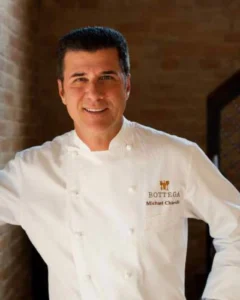
Celebrity chef Michael Chiarello headlined the 2006 Interactive Dinner
Friday night was devoted solely to the Interactive Dinner and the guest chef was popular Napa restaurateur, television chef and cookbook author (who actually had kicked off his career in South Florida) Michael Chiarello. Saturday’s dinner brought back the divide between auction and dinner dance utilizing two ballrooms at the InterContinental and longtime auctioneer Fritz Hatton was joined by Sotheby’s top wine expert Jamie
Ritchie for a hugely successful auction. Spread now over three days and nights, the event was glamorous and lucrative for the charities but also extremely demanding on the charities’ event staffs. And with that thought, I leave you to a glass (or bottle) on your own before we pick up our story next week (and I’ll bring along some recipes then!) Cheers!
*A footnote for detail geeks: if you’ve been keeping track, the festival numbering seems a little wonky up to this point. That’s because the auction began in 1996 and The Biltmore International Wine Festival began in 1997 and the two fully joined together in 1998 when, for the detail oriented, we billed it in some materials as, “the Third Great South Florida Fine Wine Auction at the Second Annual Biltmore International Wine Festival.” This got terribly confusing, so in 2003 we essentially skipped the confusion of having the eighth auction at the seventh festival, and just called it the Eighth Festival – there was no Seventh festival per se. And when the event was renamed and moved from The Biltmore to the Hotel InterContinental in 2006 it was The Ninth Annual Miami Wine & Food Festival, and the numbering was consistent from then on. Well, mostly, but that’s another detail for a future post!
The Art of Wine
Since its beginnings at the turn of the 20th century, Miami (by which I mean the greater Miami area) has been a youthful city obsessed with design. Art deco was a huge influence in Miami and Miami Beach in the 1920s and 1930s, and South Florida still has the largest concentration of Art Deco buildings in the world. This ornate style was an outgrowth of English, French and Italian influences, and here it gradually combined with a fascination with the Moorish architecture of medieval Spain to create a style called Mediterranean Revival. That style was at the heart of George Merrick’s pioneering vision (with architect Addison Mizner and others) for Coral Gables, where The Biltmore Hotel, the site of our festival in its early years, is one of the grandest examples of this style.
Style – for better and for worse, from architecture to painting to fashion to a laidback Caribbean vibe, has been a dominant element in how South Florida perceives and projects itself. This is an area captivated by its history of glamour and glitz and a dynamic energy about modern art. Art is alive in South Florida, from the annual international Art Basel festival to the flourishing gallery scene, and that dynamism was part of our festival’s early days as well.
Since the beginnings in 1996 of what is now called VeritageMiami, art has had a role in our event. Wonderful art has captured the joy of wine and the role that wine has played in human life for more than 8,000 years. It also conveys the joy of this event amid these surroundings in particular. This week, I thought it would be good to share some of that art with you. I’ve included some of our covers in previous posts, so now let’s explore, not only the art, but the artists who created it.
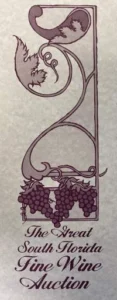 When the Great South Florida Fine Wine Auction started this celebration of wine, we weren’t sure where it would go and opted for a rather simple design that could double as a logo as well as the cover for our auction catalog. It’s a design that captures South Florida’s artistic bond with art deco by melding the graceful floral lines of the Italian precursor of art deco, called the Stile Floreale (floral style), with a fruit-laden grape vine – what could be more evocative than that? The following year the auction again used a basic design that was evocative of grapes in a night sky. The “real art” came with the creation of the festival proper with the one-night auction dinner at The Biltmore Hotel in April 1997.
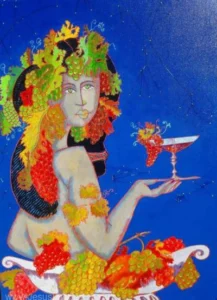
“Bacchus” by Jesus Fuertes, 1997
For this first event, we turned to the Spanish artist Jesus Fuertes to create a painting to project an image of what we wanted to be as a festival. Fuertes was a protégé of Picasso and Dali in his youth then formed his own “neo-cubist” vision (he also called it “soft cubism”) as he moved from Spain to France to Brazil, always seeking studio space with plenty of sun and water. In the 1990s, he relocated his studio to Coconut Grove and opened a gallery on Eighth Street, better known to locals as Calle Ocho, the heart of Little Havana. Fuertes flourished in his own “blue period” (infinitely sunnier than that of Picasso) and even said he wanted to thenceforth be known as “the painter of the blue.”
“The blue” was prominent in his first painting for The Biltmore International Wine Festival in 1997. I like to think it reflected his happiness in his new home and he certainly embraced the theme in both title and subject, calling his painting “Bacchus.” This is a very modern Bacchus showcasing Fuertes’s “tropical neo-cubism” with a richness and elegance that suited The Biltmore venue that shimmers in the distance. I can quibble over Bacchus, who should know better, using a saucer glass instead of a proper wine glass, but why be picky with such an evocative painting?
1998 Biltmore International Wine Festival program cover and auction painting (Credit: Jesus Fuertes)
The following year, we again turned to Jesus Fuertes for the festival artwork and got something entirely different. I love this piece, which is altogether more sun-drenched than Bacchus and carries with it a bit of Victorian propriety (and please do note that this year the couple in the painting are using proper wine glasses). This piece must have had a title, but it was never shared with us and the print that still hangs in our office only bears a number, 18/32. In my mind, it’s just “The Sunny Winos,” to be sure a title that is less grand than the event itself, but it works for me.
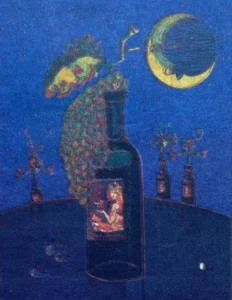
1999 Festival Cover Art by Jesus Fuertes
Fuertes’s art was so popular with our audience that we featured a third piece of his, again untitled, and unfortunately rather low resolution but my copy still shows Fuertes’s love of blue and his clever way of including elements like the moon over Miami, the grapes and recalling his 1997 image of Bacchus now envisioned as a wine label. Sadly, Jesus Fuertes passed away in 2006, though his daughter Astrid carries on his atelier via the internet at www.jesusfuertes.com where a giclée of the 1997 festival painting is still available for sale (at roughly the cost of a case of Château Lafite).
2000 Biltmore Great South Florida Wine Festival program presented by Merrill Lynch (Credit: Patou)
After three years featuring the art of Jesus Fuertes, in 2000 we welcomed the new millennium with a new painter and a dramatic shift in style. From the neo-cubism of the previous three years, we move to densely layered oils by the artist Patou. French and American by birth and raised in Monte Carlo, she traveled extensively as a young artist, absorbing influences in Asia and Africa as well as Europe before settling in Haiti in the late 1980s. It was there she says that she, “left all kinds of figures behind” and embraced abstract expression. She also discovered a talent for design and created lines of jewelry and furniture. Eventually she settled in Florida and we were one of the fortunate recipients of her artistic expression here. She brought the abstractionist’s eye to our vision, eschewing the people who populated our earlier covers and focusing solely on the grape. For the catalog in 2000, her painting is a multi-colored bunch of grapes with just a tiny bit of vine attached along with two leaves. The bunch though encompasses all of wine, carrying both red and white grapes in its pendulous beauty.
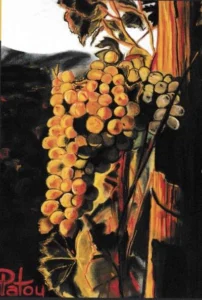
2001 Festival Cover Art by Patou
The following year, Patou again turned to the grape but in a much less rustic style. In the 2001 painting, a single bunch again contains both red and white grapes but it carries an almost da Vinci-like sense of sunlit shading against rolling Tuscan hills. Where the earlier painting was signed in ink the color of cabernet sauvignon, here she gives her signature a blast of red like pinot noir against firelight. Patou opened two galleries in 2006, one in Miami and one at DCOTA in Broward, and she also has a presence in Naples. Her work can be found on her website, www.patou.us
In 2002, another dynamic, multi-national artist joined our portfolio. Gilda Sacasas is a prolific and self-taught Cuban-American artist known for her work in several media, including painting and ceramics. I admire her precise and arresting sense of color and, to me at least, her playful geometry in how she places the figures in her artwork (she is very much a people painter). She has been an active promoter of the giclée technique, a process where she creates an original painting then digitally reproduces it with archival pigment inks. This is like a lithograph for the computer age, an artist-supervised process of creating a limited edition of high-quality art works (you can see many examples on her website, www.sacasas.com).
2002 Biltmore Great South Florida Wine Festival’s Grand Wine & Food Tasting presented by Diageo and in cooperation with Wine Spectator (Credit: Gilda Sacasas)
Gilda has been exhibiting since 1989 and opened her own gallery in Coral Gables, in 1998. In her art, she focuses on several subjects including music and musicians, romance and café life. And of course, wine. She has been particularly active creating art for South Florida charities but I think her gorgeous poster for The Biltmore Great South Florida Wine Festival in 2002 is uniquely beautiful. A single taster is sitting somewhere on the upper level of the Biltmore’s Country Club Ballroom where our tastings were held, and you can see the hotel’s main building glimmering in the background. She has a glass of red wine in her hand (and two glasses of white off to the side, perhaps for a vinous assignation after the bidding is finished) and she is sampling the bouquet as a cloud of stars wafts from the glass. Ahem, waiter, I’ll have what she’s drinking.
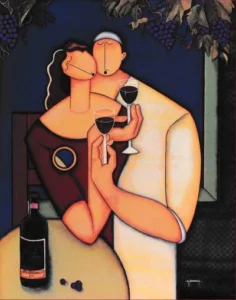
“La Vie” by Gilda Sacasas, 2003
The following year, our taster is back, this time with her paramour, and they each have a glass from a bottle of “The Biltmore 2003” on the table in front of them. Apparently, they are in a pergola, a growing area with overhead trellising as there are bunches of grapes hanging above them. I always thought this painting summed up The Biltmore Great South Florida Wine Festival – wine lovers having a transcendent experience of sharing and generosity. I loved the way Sacasas plugged right into the spirit of the event, and we were honored by her generosity in creating a painting that was not only featured on the festival catalogs that year but that was also donated to our auction to help raise funds.
This year, 2003, was our final year at The Biltmore (I will explain the transition next week, so watch this space). In 2004, the festival moved to a larger space at the InterContinental Miami (where, with only a couple of exceptions, we have continued to hold the event to this day) and with the move came a more commercial vision for our artistic representation. While we were at The Biltmore, the hotel exerted a powerful influence on the design of the auction catalog, wanting a publication (albeit an expensive one) that promoted the property’s luxury image. With the move in 2004, we seized an opportunity to create a less artistic but more brand-centric vision for the publications. We wanted a look and feel that could extend to all sorts of material, from press kits to staff badges as well as giving a more modern sense of vibrancy to the auction catalogs and tasting guides.
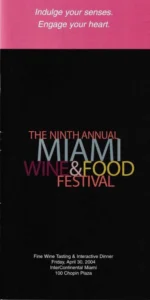
2004 Festival Tasting Cover
In 2004, that look and feel capitalized on the modern vision of Miami-deco (think the bright colors of Miami Vice meeting a clean, modern aesthetic). Flamingo pink had to play a role, but so did a multi-color palette to reflect the multi-flavor palate of the wines on display. And thus a new look – it was pink and black punctuated by the colors of Provence rosé, grand cru Burgundy, Napa chardonnay and Miami twilight. It was the new look of the newly christened  Miami Wine & Food Festival and ushered in a trend of having logos and branding rather than artwork. The following year in 2005, we introduced the hybrid corkscrew and palm tree that symbolized our event for a decade. It’s one of my favorite bits of imagery around this great event and one I treasure. I just can’t use it to open a wine bottle.
Hunger Pangs, the Chefs (and Recipes) of Veritage Miami, PT. 1
In addition to its mission to support the charitable efforts of United Way of Miami-Dade, our wine and food festival is about, well, wine and food! Since the first Great South Florida Wine Auction in 1996, the event has been driven by the art of pairing wine and food and we have been blessed over the years to have had more than 100 chefs participate in the event. As many as 25 restaurants would join the wine tasting that for many years opened each year’s festival and with the inclusion of the Craft Beer Tasting (more on that next week!) another 15 to 25 restaurants would be on hand. Sommeliers from top South Florida restaurants have always been important participants, especially for the nearly ten years our event included the Best in Glass Wine Challenge. There have been memorable meals with guest chefs at the auction dinner, but, always, the “big ticket” signature event for most of our guests has been the Interactive Dinner.
If you’ve never been, you have really missed something special. A guest chef (or, many years, guest chefs) have a cooking station on a raised stage and our guests, 500 to 750 strong depending on the year, have cooking stations at each of their tables. That means one cooking station for every eight or nine guests … more than 75 in total and one year, nearly 100! At each of these tables, the guests would elect (or often, bribe and cajole) their friends to be the chef for one of the three or four courses. Often a table would have an alpha cook who was happy to man the burner for the entire meal, and other tables ended up having everyone cook at least part of one of the courses. Mind you, the entire process is fueled by copious amounts of wine, some supplied by VeritageMiami of course, but many guests use the Interactive Dinner as an opportunity to bring wines from home to share with their friends. I have had the privilege to taste some amazing wines simply by strolling through the ballroom at this event!
Looking back over 13 years of menus (this post is limited to the first years of VeritageMiami, with another chef retrospective to come in a few weeks to cover the most recent years), some meals stand out and some chef experiences remain firmly etched in my memory. I’ll never forget the interactive brunch in 2002 (this was before we converted the event to a dinner). Rocco di Spirito, later to become a household name but then mainly known as a New York wunderkind chef, offered his lobster salad from Union Pacific restaurant and then Wayne Nish of March (also in New York) had us all making slow-cooked salmon with wild mushrooms. Then, veering away from the East Coast, the meal wrapped up with Dean Fearing, the chef at The Mansion on Turtle Creek in Dallas.
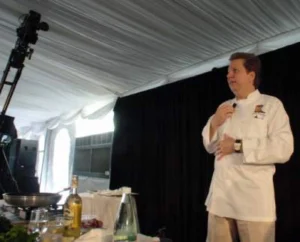
Chef Dean Fearing at the 2002 Interactive Culinary Fest at the Biltmore Hotel
Chef Fearing sent us his recipe in advance so we could prep the list of ingredients, including a full bottle of tequila for each cooking station. I thought it was great having tequila as an ingredient with a Texas chef, and it was hilarious when he took the stage after the first two courses and had all the guests down a shot of tequila before they started cooking his plate. It completely set the stage for a joyfully informal occasion as he went on to tutor everyone in preparing “Crispy and Spicy Lamb Chops, Roasted Garlic Horseradish Sauce and Country Scalloped Potatoes.”
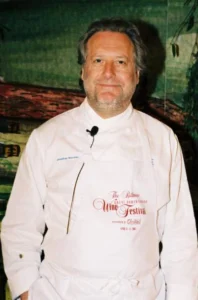 In 2003 I was very excited one of my heroes, Jonathan Waxman from New York’s Washington Park, was featured at the Saturday auction dinner (a classic rack of lamb) and then at Sunday’s interactive lunch insisted on making a foie gras taco with cherry and avocado salsa and a jicama salad. What looked great on paper was a mess to make as amateur chefs were trying to pan sear foie gras without burning it. And, when we all finally got the taco assembled, Jonathan instructed everyone to pick it up with their hands, and it promptly ran down everyone’s arms. Oh, but it tasted great!
Having multiple celebrity chefs at the interactive brunch (and, from 2004 on, the Interactive Dinner) was fun but with each chef trying to outdo his or her colleagues it got to be a sometimes-unwieldy meal. With 2005, we began featuring a single celebrity chef who could craft a cohesive menu by preparing all the courses. Usually, this meant three courses prepared by the audience under the chef’s guidance and then dessert prepared by the terrific team at our regular venue, the InterContinental Miami.
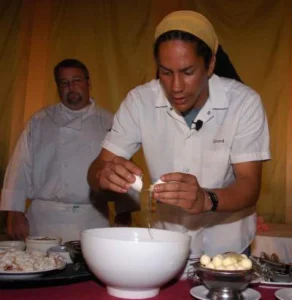
Chef Govind Armstrong, our first solo chef to headline our newly branded Miami Wine and Food Festival in 2005
Govind Armstrong was our first solo celebrity chef, and he did a dazzling job (want his menu and recipes? You will find them here!) He was easy to work with and totally got the concept of creating a menu people can prepare with limited equipment: a single burner, a couple of pans, a few utensils and a lot of wine. We went from Dungeness crab fritters to pan-seared dorade to pan-seared beef medallions dressed up with mushrooms and foie gras. Govind was wonderfully personable and I thought he hit it out of the park with the menu.
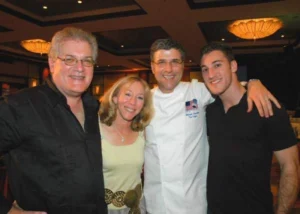
Mike drop! Chef Michael Chiarello with Michael Bittel, wife Linda and son (and United Way volunteer) Matt at the 2006 Interactive Dinner
In 2006 Michael Chiarello joined us thanks to the strong connection one of our founders, wine retailer Mike Bittel, had with him. By 2006, Chiarello was a famous chef with a trio of restaurants in Napa as well as several television shows. Bittel had known Chiarello in the 1980s when he was a student at Florida International University’s acclaimed hospitality school then had become chef at Coconut Grove’s Grand Bay Hotel before opening Toby’s Bar and Grill. Named Chef of the Year in 1985 by Food & Wine Magazine, Chiarello got an irresistible offer to move to Napa in 1986 but stayed in touch with friends in Miami. Fortunately for us, Mike Bittel’s persuasion got him to come back with a terrific menu featuring his Cal-Italia cooking style. We got some odd looks from guests at the Interactive Dinner when they learned we would be making gazpacho garnished with popcorn (it was amazing). The whole menu was dazzling especially because Michael gave each recipe such a genial introduction (I’ve included his comments as well as the recipes here). And lest I forget, that olive oil cake is amazing!
In 2007, the incredibly inspiring Marcus Samuelsson was the chef and, as I mentioned in last week’s post, he was funny, humble and filled with great stories. I spent quite a bit of time with him, including driving him to meet with students at Johnson & Wales University – the same student body that, year after year sends fabulous young chefs in training to serve as “sous chefs” on the floor with our guests. They were mesmerized by Marcus’s stories and the image of a person of color transforming America’s culinary landscape (as he continues to do). The adoring looks on those students’ faces as Marcus was preparing the dinner a few nights later remains one of the priceless perks of my job with VeritageMiami.
Marcus’s menu was everything we wanted – brilliantly eclectic, incredibly flavorful, easy to prepare and filled with heart and storytelling. To this day, it is one of my favorite festival meals: shrimp piri piri with chilled avocado soup; Kofta meatballs with okra tomato sauce (the sauce as good as the meatballs); lamb chops crusted with Berbere spice and shown off with mango couscous and mustard greens; tangerine consommé with honey ice cream. Awesome in every way, and I can share the recipes with you here!
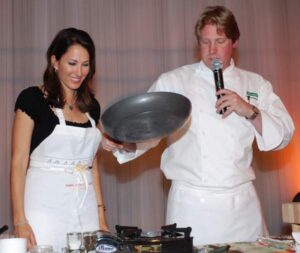
Chef Stephen Lewandowski with a volunteer sous chef on stage at the 2008 Interactive Dinner
The chef for 2008 was a great friend of mine, Stephen Lewandowski, the then-executive chef of New York’s Tribeca Grill (yes, owned by Robert DiNero about whom Stephen could tell fun stories). Stephen and I had traveled together several times so I knew we’d get a supremely flavorful menu, cuisine he liked to call “earthy” and which I would describe as “heavenly.” His curried chickpea and tomato soup was surprisingly light but soul satisfying and I’ve continued to make it for friends to this day. His seared scallops (it was he who got me hooked on the then new concept of “diver scallops”) were pan-seared with corn, asparagus, morels (which due to a typo in the menu were called morsels) and a truffle-Madeira vinaigrette. This was one of the most complex-flavored one-pan meals I’ve had at the festival dinners, which reminds me I need to make this dish again! His black trumpet mushroom-crusted lamb loin with spring vegetables and risotto was another of those dishes where it comes together so quickly in the pan you can’t believe it is so deeply flavored on the plate. It was … it is memorable, and all the recipes are right here.
The last of the menus I’ll include this week is another that has lingered in my memory. I had met Michael Schwartz in the 1990s when I was restaurant critic for the Sun-Sentinel newspaper and he opened a dazzling seafood restaurant on South Beach called Nemo. He was a featured chef at the very first Great South Florida Wine Auction in 1996 after which I managed dinners wherever he was cooking. I was right in line at the front door when he finally opened his own restaurant in 2007, the now legendary Michael’s Genuine Food and Drink in the, at the time, nearly barren Design District.
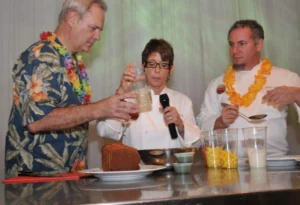
Chefs Hedy Goldsmith and Michael Schwartz give Festival Director Lyn Farmer his just desserts
The restaurant not only featured Michael but also South Florida’s Doyenne of Desserts, pastry chef extraordinaire Hedy Goldsmith. I asked them both to headline the dinner and they pulled out all the stops with wild salmon crudo “cooked” with hot citrus oil and shaved garlic and hearts of palm, followed by exotic mushroom risotto. We had always stayed away from letting chefs do risotto because it’s time consuming, impossible to make with one pot (you need to cook the rice but keep the stock warm in another pan) and technically demanding. “No worries,” said Michael, “I’ve got this,” and he did – the dish was a knockout and (at most tables) turned out amazingly well. He finished with pan-roasted strip steak with a wonderfully fresh salad of fennel, radish, fregola (wheat kernels), arugula, orange and tapenade.
And after all this, Hedy came to the stage. Since I was the emcee, she insisted I join her at the chef’s demo table (I will never fight getting a hands-on dessert lesson) because she was worried about being in front of 700 people. You would never have known she was nervous once she started assembling her key lime cake with coconut anglaise that included a nod to the evening’s cocktail sponsor Bacardi, a fruit salsa with coconut rum. It was divine and we all wanted more as we staggered out of the ballroom that night. You can work your way through all four of Michael’s and Hedy’s recipes here, while I run to the kitchen to make a snack.
I’ll be back next week to chronicle the festival’s progression from 2010 onward. In the meantime, cheers, and please pass the salsa …
Going it (Sort of) Alone
Written by VeritageMiami Director Lyn Farmer
Following the successful close of the Miami Wine and Food Festival in spring 2006, the event’s success was exhausting those who staged it.
The reality is that large charities need to stage events throughout the year to generate both participation and to maintain visibility. One mantra I heard frequently was, “the week of the event everyone knows you, but 51 weeks a year no one ever heard of you.” It wasn’t quite that stark, but by this time, the “wine festival” (it included food and lifestyle, but in-house, it was always “the wine festival”) required attention throughout the year. Unlike many events the two charities staged, this was one event in name, but in practice, it was three events spread over a weekend, each attracting a slightly different demographic.
The wine tasting on Thursday night at Merrick Park drew a crowd of more than 1,200 people and, thanks in part to a huge variety of wine on offer as well as its attractive ticket price (a steal at $75) was very appealing to a young audience. The Interactive Dinner, now called “Food, Friends & Fun”, on Friday night was a raucous, infectious good time that, despite a high-ticket price, had grown to more than 600 attendees looking for a fun time with great food. And then there was the dinner (and sometimes both a dinner and dinner dance) on Saturday night that featured the auction that supplied most of the net income for the charities. This also commanded a high-ticket price and attracted a crowd that dressed in formal wear for a fashionable night out.
By Sunday, the staff was exhausted after working three long days and, while the audience was ready to relax, the event team was already hard at work on another event, often coming up in just a few weeks. It was tiring and after a lot of discussion, the two charity partners that had created the event and carried it forward for a decade decided to part ways. Baptist Health South Florida Foundation wanted to focus on other, less staff-intensive events and United Way of Miami-Dade, with a larger event staff, took on sole ownership of the festival while still looking to broaden its base.
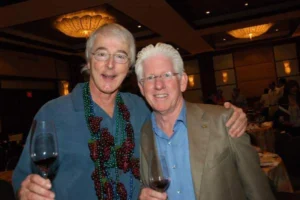
Festival Chair Bob Dickinson with Bill Talbert of the Greater Miami Convention and Visitors Bureau at the 2007 Food, Friends and Fun
A key player in the decision to broaden the base was Bob Dickinson, a nationally influential wine collector who was also president of Carnival Cruise Line. In addition to wine, Bob’s great passion was supporting two South Florida charities, United Way of Miami-Dade and Camillus House. With his encouragement, Camillus House became a partner beginning with The Twelve Annual Miami Wine and Food Festival in 2007.
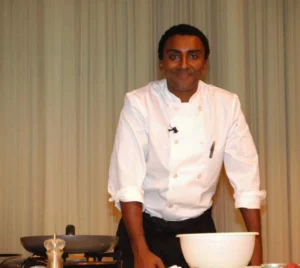
Marcus Samuelsson, our Interactive chef in 2007
The festival kicked off Friday, March 22 with the Taste and Toast Fine Wine Tasting at Merrick Park, continued with the Interactive Dinner headlined by Marcus Samuelsson. Samuelsson, an Ethiopian refugee raised by adoptive parents in Sweden, had a compelling story that added a lot of human interest to his significant cooking cachet at a string of New York restaurants, but 14 years ago he wasn’t nearly so well known outside Manhattan as he is today. For many in our audience in 2007, his sparkling personality, humble demeanor and dazzling cooking skills were a revelation and he was a wildly popular chef on both Friday and then again Saturday when he and InterContinental Miami’s executive chef Alex Feher created a memorable meal for the first auction lunch.
Staging the auction as an afternoon event was aimed at creating a less formal event than the black-tie dinner auctions of the past. Fritz Hatton again presided over the offering of 61 lots in the live auction (and many more in an extensive silent auction) that started at 12:30 and went on past 4 pm before the final gavel came down. To be honest, the auction that year was a struggle, and ended up being a one-year experiment that everyone agreed lacked some of the enthusiasm of past evening events, so in 2008, we returned to the classic auction dinner format.
In 2008, and back to an evening auction, we also pared down the list of auction lots in response to some patrons feeling the auction went on too long. It has always been a balancing act between packaging a great evening of entertainment that has a definite flow and the need for the charities to maximize yield so we held the auction to 51 lots.
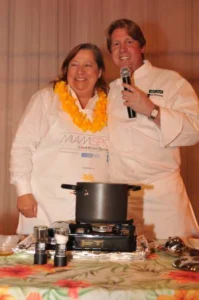
Nelly Farra with chef Stephen Lewandowski at the 2008 Interactive Dinner
At Friday’s Interactive Dinner, our guest chef was Stephen Lewandowski, a dynamic young American chef who held the influential executive chef position at Tribeca Grill in New York. Like many younger chefs we worked with, Lewandowski embraced the interactive concept with gusto and created a terrific menu that many of us went on to duplicate at home – I had his curried chick pea and tomato soup and his black trumpet mushroom-dusted lamb loin on my dinner party rotation for a couple of years after that evening!
The Fourteenth Annual Miami Wine and Food Festival opened on April 23, 2009, with Taste & Toast at Merrick Park. By now this was as memorable a signature event as the Food, Friends & Fun Interactive Dinner and, to some extent, dictated our event timing. Miami has gradually become less seasonal than it once was but we are still aware that many winter residents head north as the weather warms. With several religious holidays in the spring also limiting dates and the propensity of Miami weather to get very warm and rainy by early May, we’ve generally stuck with dates in March or April. This year was one of our latest events and, because of a schedule conflict at InterContinental Miami, we had to move the Interactive Dinner to the then-new JW Marriott Hotel Miami in downtown.
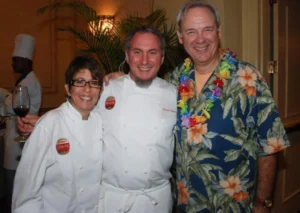
Chefs Hedy Goldsmith and Michael Schwartz with Festival Director Lyn Farmer
For the Interactive Dinner on Friday, April 24, we featured the dynamic duo of Michael Schwartz and Hedy Goldsmith. After several years heading up area restaurants for other owners, Schwartz had recently opened his own place, Michael’s Genuine Food & Drink with Goldsmith as his pastry chef. Our standard program in the past had been to have our celebrity chef lead the audience in preparing three courses, and then Feher’s team at the InterContinental would prepare a dessert suggested by the chef. But with Schwartz, we also had a world-class pastry chef in the mix, so we featured four dishes on the Interactive lineup. It was a stellar evening to pave the way for the following night’s auction and, not incidentally, Schwartz went on a year later to win the prestigious James Beard Foundation Award as best chef in the South.
It’s high time I shared some of these recipes with you, so next week I’ll take a look back over some of my favorite recipes (and favorite chef stories) from the first half of the festival’s life. It will be an epic multi-course extravaganza spiced up with a little behind-the-scenes gossip!
Cheers!
Giving the Event an English Accent
We have had a single vision from the very beginning of this event – to raise funds for and awareness of the mission of United Way of Miami-Dade. We were the first major and annual charity wine and food festival in South Florida and while many others have come (and some gone) over these past 25 years, this event’s mission has been constant. The name, however, has not – there have been a lot of tweaks to the festival’s name!
As we’ve added partners and venues over the years, we’ve made name changes to reflect who and where we are, from the Great South Florida Fine Wine Auction to the Miami Wine & Food Festival. We started as a single-day auction only (see my first post in the series) but quickly moved into a multi-day event and were well established by 2010. The Taste & Toast Fine Wine Tasting at Merrick Park was hugely popular, especially with some of our younger supporters, thanks to a relatively low entry cost – most years it was just $75 for a general admission ticket (there was a VIP ticket that allowed earlier entry for a higher price) that gave tasters access to as many as 75 wineries pouring samples plus 20-25 restaurants offering tasting bites to pair with the wine.
This is a good place for me to mention what I think of as a hallmark of our event and one reason for our success with wineries over the years. Wineries participate in events like ours partly out of a sense of community engagement but also for visibility. Many of the winemakers and representatives I spoke with noted that while some wine events just end up like a wine-filled free for all (they used the term “drunkfest”), our event was spaced out in such a way and our clientele was such that they would stop and chat with producers, ask questions about the wine and, in general, taste thoughtfully. This meant, to be blunt, they’d remember what they tasted and what they liked the next day and could become customers, which meant the event was a win-win for all concerned.
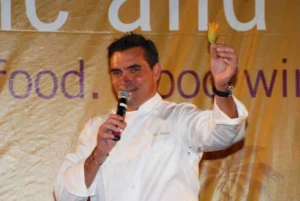
Celebrity chef Todd English headlined the 2010 Interactive Dinner
The highlight of 2010’s festival was having chef Todd English join us for the Interactive Dinner. English, with his movie star looks and larger than life personality, pushed us to new levels of culinary creativity with a dynamic menu and an energetic presence that prompted us to create an auction for Friday night’s dinner as well as the customary Saturday event, and both were a great success for both beneficiaries, United Way and Camillus House.
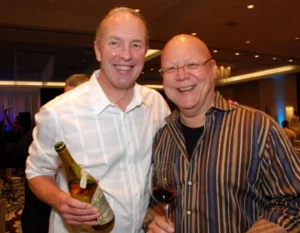
Festival chair Dan Hanrahan and festival trustee Oscar Suarez at the 16th Annual United Way Miami Wine and Food Festival.
Two interesting things happened after the 2010 festival: Camillus House, who had partnered with us for several years, decided to do their own, separate event leaving United Way of Miami-Dade as the sole organizer and beneficiary, and Dan Hanrahan, then the CEO of Celebrity Cruise Line, joined our board as chairman. Dan was an incredible visionary, a wonderfully outgoing campaigner for the event and also very organized and imaginative. Under his leadership, we pushed forward with ever more innovative events, and in the process changed the name to reflect our ownership and became the 16th Annual United Way Miami Wine & Food Festival.
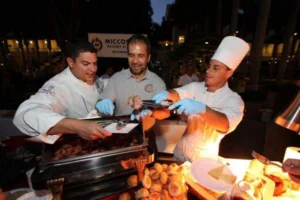
Taste & Toast sponsors, Miccosukee Resort & Gaming, cooking up a storm
With a new push for sponsorship (ticket fees only cover part of the cost of staging events like this) the Miccosukee Tribe became title sponsor of the Merrick Park tasting event; Bacardi USA joined us as the title sponsor of the Interactive Dinner, this year called, “Food, Friends and Fun,” and featuring popular local chef Dewey LoSasso. And in addition to the Saturday evening auction dinner, we added a fourth event to the festival, a craft beer festival.
Looking back, this was an exciting option that has helped solidify our support with younger attendees and also helped us embrace a terrifically innovative part of the beverage industry. That first year, the Craft Beer Tasting was a Sunday afternoon event held at Mary Brickell Village. It was a huge success, especially in the eyes of the beer industry, which told us they seldom encountered so professionally managed an event. That tasting began a love affair between us and the craft beer industry that continues to this day as we have for 10 years now welcomed more than 40 brewers to the festival.
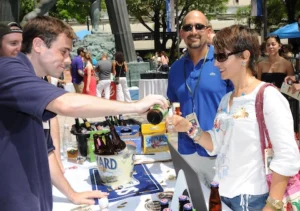
Shipyard Brewing at Craft Beer Tasting at Mary Brickell Village
In 2012 a scheduling conflict with our usual home at the Hotel InterContinental led us to stage the festival at the Fontainebleau Hotel on Miami Beach. We preceded the Interactive Dinner with the Craft Beer Tasting, moving it to Thursday night as our opening event, then followed up with the Merrick Park tasting on Friday. Kevin Sbragia, a winner on Top Chef (he took home the honors on Season 9) joined us for the Interactive and created a stir by featuring a liquid nitrogen-frozen ice cream for dessert. The room was filled with fog for a bit but it was terrific fun.
Saturday, the fun at the Fontainebleau continued with a great meal prepared by Thomas Connell, the hotel’s executive chef, and the auction was a great success, though the consensus among many contributors was that staging the event on Miami Beach didn’t really fit our profile. We’d always been on the mainland and they pushed for a return. Little did the staff realize just how much of an about-face that return would be as the following year brought us not only a change of venue but a new name as well. But that is a story for another time – next week to be precise, when I’ll be back with another look at how we, soon to be officially known as VeritageMiami, came to be 25 years old.
Cheers!
Where’s the Wine
Along this historical journey, you have read about us as The Great South Florida Fine Wine Auction, The Biltmore International Wine Festival at Coral Gables, The Biltmore Great South Florida Wine Festival, the Miami Wine and Food Festival and the United Way Miami Wine & Food Festival. Ampersands have come and gone (and returned), but one word has always been in our name: Wine. We started as a “wine auction,” and continued as a “wine festival” and while we always had a strong component of food in both concept and execution, it was wine that always took center stage. And then we became VeritageMiami and suddenly, no wine, no food, no festival – at least not in our title though all those elements were in the event more strongly than ever.
What’s up with that?
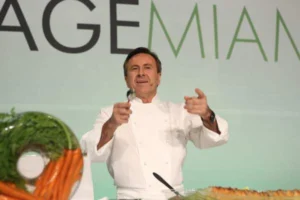
Chef Daniel Boulud guiding guests from stage at the Interactive Dinner in 2013
In 2013, Dan Hanrahan ended his two-year term as festival chair and ceded the spot to Richard Fain, the chairman of Royal Caribbean Cruise Line. Fain had a reputation as a marketing genius, and he wasted no time challenging the staff and the festival board. We may have been the only wine festival game in town when we began, but by 2013, the South Florida charity landscape was littered with wine and food festivals. Fain wanted a change in name if not in mission, arguing we needed a way to set ourselves apart from the now-crowded field. His idea, in a nutshell, was, “We are different, let’s sound different.” We spent weeks in brainstorming sessions with marketing gurus around the country and Richard constantly prodded us to think not so much of what we were (which he thought was fine), but how we wanted to be perceived: fun, imaginative, and wine focused. The emphasis needs to be on perception, he urged.
I don’t remember the exact moment the name Veritage hit us, but it wasn’t from one of the outside consultants (though I don’t estimate their value in getting us thinking outside the wine box). Several of us were sitting in Tammy Klingler’s office (she was the then Senior VP of Marketing and Communications at United Way) musing on a way to convey wine without using the word. We got talking about a similar issue the California wine industry had in the trying to say they were making red blends like those produced in Bordeaux, but couldn’t use the term Bordeaux, and the idea hit us.
 Napa producers were using the term “meritage,” and having endless difficulties getting people not to pronounce it “mer-it-ahzh” as if it were French. We jumped on the term “Veritage” and we were fine giving it a French accent and leaving in some vagueness as to whether it referred to veraison, the term used to indicate the onset of ripening in wine grapes (or, more precisely, the moment when grapes change color from green to either gold or purple), or grape variety. I confess to being happy to let people also confuse the word with “verity” (which itself is an English word derived from the French word for truth), vernissage, a word that in the art world denotes a preview of an exhibit, or even more tenuous links with winey words like viticulture or vinification. We embraced it all, and Veritage was born … and quickly compounded into VeritageMiami as a single word to brand the festival.
Working with an outside graphic designer, our own design team developed a logo that replaced the paintings that had once represented the festival with a single design that came to promote the festival every year – a hybrid palm tree and cork screw. It was only later that we hit on the full logo package of a unique springtime green and using the typeface Futura (and its several permutations) to make a consistent graphic representation.
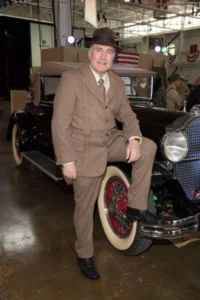
His Royal Corkscrew, aka Richard Fain, at VeritageMiami’s Auction & Dinner held at Orion Jet Center
With the name chosen, Richard Fain continued to press for a way to underscore the fun side of the festival. One way was to havewhimsical titles for many of our volunteers as if they were all characters in a wine-fueled version of Alice in Wonderland (or more to the point, Through the Wine Glass). Richard became “His Royal Corkscrew,” our event chairs were Masters of Fundom of the First Night, Second Night and Third Night (we were still staging the festival on consecutive evenings at that point). I was to become The Imperial Imbiber and was charged with writing elaborately punny blog posts around the time of the festival (with many of the phrases looking in hindsight as though they were constructed while I was very much under the influence of a cru Bourgeoise.)
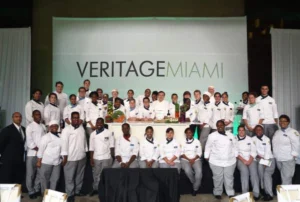
Chef Daniel Boulud with the Interactive Dinner’s sous chefs, Johnson & Wales University culinary students
Fain wanted us to not only think outside the box, but stage the event outside the usual venues, but I should note at this point that was not the main reason we held the 2013 Interactive Dinner at the Marriott Marquis hotel in downtown Miami and not at our traditional venue at the InterContinental Miami. The reason we went to the Marriott Marquis was because we could get Daniel Boulud to be our guest chef if we held the event at the hotel where he had a namesake restaurant, and while it was a smaller space that hampered mobility and reduced the number of lots at the silent auction, the dinner was brilliant and the evening was a huge success.
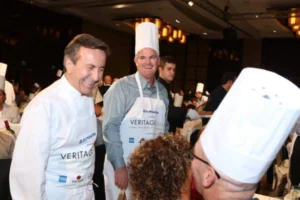
Chef Daniel Boulud getting interactive with guests at United Way’s incoming board chair Gene Schaefer’s table
Working with Daniel Boulud was a partnership made in heaven for any wine and food lover. Boulud was an extremely polished guest chef, a dream to work with between his wonderful menu, stunning organization, and innate understanding of the way an interactive event could work. He was a culinary idol of mine, and I relished the chance to work with him on making the event memorable, and for our volunteers from Johnson & Wales University’s culinary school, he was a dazzling taskmaster. I will never forget the enormous amount of time and coaching he gave the students and his winning way with our audience.
Where we did break out of the venue box was in staging the Saturday dinner that year at the Orion Jet Center, with the huge airplane hangar decorated as if it were a stage set for a World War II film. This is where Richard Fain’s keen instinct for marketing (and, I have to say, his show business flair) was evident in a magnificent way. His Royal Corkscrew had made the mark he intended, and it put VeritageMiami on a more visible, fun-filled course, something we’ll explore further next time!
Until then, cheers!
Crush for a Cuase
Written by VeritageMiami Director Lyn Farmer
I noted last week that we, at the now re-christened VeritageMiami, got a real showbiz shot in the arm when Richard Fain became our festival chairman and urged us into ever greater public outreach with the event. While 2013 had brought some exciting events along with the name change, 2014 had us pushing toward even more innovative ways to reach out with not only His Royal Corkscrew urging us on but also with the support of City National Bank.
CNB joined us in 2013 as the title sponsor of the Interactive Dinner and went on to become the presenting sponsor of the entire festival. It has been a rewarding relationship offering both stability and the inspired business acumen of CNB Chairman Jorge Gonzalez who, along with his wife Melinda also served three years as festival co-chair and has been an extraordinary fundraiser for the event. For our guests, the festival has been about fun as well as serving to harness support to the South Florida community. The festival has also proved to be a great vehicle for networking as it has served as an inspiration for events like United Way’s Young Leaders own interactive function BYOB (Build Your Own Brunch) and as an umbrella event for the Associates Legal Mingle that brought together young associates from Miami’s major law firms for a wine and cocktail prelude prior to a VeritageMiami event.
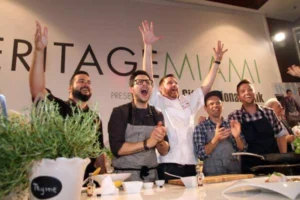
VeritageMiami’s Fab Five – Chefs José Mendín, Giorgio Rapicavoli, Alberto Cabrera, Cesar Zapata and Todd Erickson
Another key relationship dating to 2014’s VeritageMiami was with Indulge Magazine, a luxury lifestyle publication of the Miami Herald. I served as the magazine’s beverage columnist for several years after its debut in 2012, but VeritageMiami’s relationship began in 2014 with the magazine’s annual food issue. Rather than a single chef being highlighted in the cover story, the February/March issue in 2014 featured five chefs, and partnering with the magazine, VeritageMiami featured all five as our guest chefs for the Interactive Dinner. It was a huge undertaking to coordinate and craft a menu with five terrific chefs, but what a great dinner we threw that year with (in order of appearance at the festival) chefs Todd Erickson, Alberto Cabrera, José Mendin, Cesar Zapata and Giorgio Rapicavoli.
The audience went crazy (or, more precisely, crazier than usual) for the chefs, going so far as to having a dozen audience members bid $100 each for a pound of the same rice Alberto Cabrera used in his Arroz con Mariscos (I’ll share all their recipes in a future post, I prom
ise!). And when we auctioned off a progressive dinner to visit each chef’s restaurant for a single course with a limo to take the group from restaurant to restaurant, the bidding got so high the chefs ended up auctioning off the dinner twice!
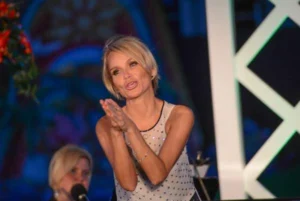
Kristin Chenoweth performs at VeritageMiami’s Auction & Wine Dinner on the Diamond at Marlins Park
There isn’t much that could have topped that evening’s Interactive Dinner, but we did our best by staging the gala auction dinner the following night not in a hotel setting (and not repeating the previous year’s dinner in an airplane hangar) but by setting tables along the base lines of Marlin’s Park, the recently completed urban stadium that was home to Miami’s National League baseball team. As if the setting weren’t unusual enough, Richard Fain in his final year as the festival chair, arranged for one of Broadway’s brightest stars (and godmother to one of his ships in the Royal Caribbean fleet) Kristin Chenoweth to join us as the evening’s star attraction. It was, in several ways, an evening with the stars thanks to stellar auction lots, Chenoweth’s moving performance and the stadium being open to the balmy April night sky. There were logistics challenges to be sure (dugouts framing auction lots? Why not!) but it was a wonderful evening for Miami’s wine lovers.
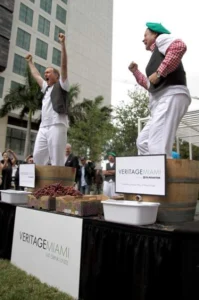
His Royal Corkscrew (aka Richard Fain) cheering his win over Allen Morris (aka Le Marquis du Vin) at the 2014 Crush-a-Thon
And, as if it were dessert after a wonderful meal, there’s one more memory I am compelled to share before closing this week’s recollections. Very much in keeping with the sense of innovation and fun that went with the VeritageMiami name, we sought out, how shall I say?, interesting ways to publicize the events. My favorite of all our efforts (and I’m not discounting the at times hilarious emails crafted for His Royal Corkscrew to send his wine slurping minions) was a press event we staged in downtown Miami with two large vats of grapes, and our normally very prestigious board members and trustees climbing in to crush grapes in a heated competition with each other. Think of that legendary scene when Lucy and Ethel stomped grapes on “I Love Lucy,” and then multiply it. Here we had Richard Fain, CEO of Royal Caribbean Cruises in a stompathon with Allen Morris, one of Miami’s leading real estate developers (and it turned out, our next festival chairman). We had partners of prestigious law firms, titans of finance and numerous others, and the spectacle definitely brought out the TV crews and newspaper scribes. We all went out afterward for real wine because they were just stomping table grapes and we were, by the end, dying of laughter and dying for a carafe or two of Napa cabernet. I miss those days.
Next week, we continue the saga and look at another group of interactive chefs, and another huge fundraising event for United Way of Miami-Dade.
Cheers!
The Chef Gangs
Written by VeritageMiami Director Lyn Farmer
In my last post I noted how much fun we had at the 2014 Interactive Dinner when, after having a single featured chef at the Interactive Dinner for many years, our partnership with Indulge magazine brought us five chefs for the event. That meant five courses rather than our usual four, and gave us a lot of buzz around town for joining the magazine in celebrating a stunning group of young chefs.
In 2015, Indulge wanted to again feature a group of chefs on the cover of its food and wine issue and we were all for that because it brought us an opportunity to highlight an important group of female chefs driving a food renaissance in South Florida. It was particularly rewarding to focus not only on young star chefs but to salute another generation as well in featuring Cindy Hutson of Ortanique who had blazed a trail for women chefs when many of the other chefs on the dais that night were toddlers.

2015 Interactive Dinner chefs Eileen Andrade, Adrianne Calvo, Cindy Hutson, Paula DaSilva and Dena Marino. (Photo: Felipe Pinzon)
Our cross-generation lineup included not only Cindy, whose signature Caribbean-inspired takes on classic dishes had made Ortanique one of the most celebrated restaurants in South Florida but, a generation younger, Eileen Andrade who brought a wealth of experience (her family-owned Cuban culinary icon Islas Canarias) to her new Caribbean style at Finca Table & Tap. Adrianne Calvo has gone on to national visibility through a number of Food Network programs (and who, incidentally, is our solo headline chef at the Interactive Dinner this year) but even six years ago, she was a powerhouse who packed in huge audiences nightly at her Chef Adrianne’s Vineyard Restaurant and Bar. Paula DaSilva has helmed some of the top kitchens in South Florida – she was at the seafood temple 3030 Ocean in Fort Lauderdale when she joined us in 2015 and now is at The Ritz-Carlton, Fort Lauderdale, and Dena Marino dazzled us with fresh pasta from her Coral Gables restaurant MC Kitchen.
I have to say this group of five chefs is particularly memorable to me because together they crafted a menu of five complimentary dishes that were also wonderfully adapted to cooking under the rather trying circumstances of the Interactive Dinner. Remember, guests are cooking dinner along with the chefs, so you have basically 75 individual pop-up restaurants in the InterContinental hotel ballroom that night, each table equipped with a single butane burner, one skillet, one pot and a few utensils. It’s a huge tribute to hotel executive chef Jhonnatan Contreras and his team that they can deliver between 75 and 90 mis en place trays for each course in a timely manner, and a tribute to our guest chefs (and yes, the VeritageMiami team for sure) that this all comes together in a timely fashion. Amazing as it always seems in retrospect, our audience is able to actually have a full dinner plated and served, a dinner they cooked for themselves!
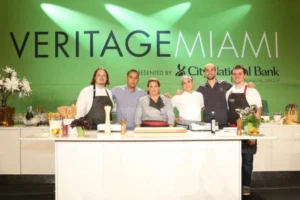
2016 Interactive Dinner chefs lineup: Brad Kilgore, Alex Chang, Nicole Votano, Julia Ning, Brian Nasajon and Justin Flit
I confess to having been skeptical the previous year that we could make this work with multiple chefs, but it worked well and then worked even better in 2015. It worked so well in fact, that the following year, 2016, we did it again by inviting not five but six chefs to join us for the Interactive, and just to make it interesting, we asked the chefs to team up so there were three courses, each created and coached by two guest chefs. Chefs are known for being leaders, not followers, and it’s a tribute to our great teams that they not only got along well but that they created an absolutely dazzling, cohesive menu.
This was an unusual dinner because we had decided to move VeritageMiami from being a March or April spring event to taking place around harvest time in the autumn. We didn’t feel we could go 18 months or longer from the spring, 2015 festival to an autumn event in 2016, so we created a second Interactive Dinner in March 2016 as a bridge event.
Our 2016 teams featured some of South Florida’s most exciting new chefs (and by new I don’t mean they were inexperienced, only that each was the executive chef at a new restaurant). Nicole Votano had just opened an organic, vegan-inspired restaurant on South Beach called Dirt and Julia Ning was developing but hadn’t yet opened a restaurant with César Zapata of The Federal (César had been in the original “chef gang” in 2014) – that restaurant eventually became the still-popular Phuc Yea.
Team Two featured two chefs who have gone on to help redefine casual dining in Miami – Brian Nasajon, whose Beaker & Gray is an amazing location for comfort food and upscale craft cocktails, and Justin Flit, who had recently opened the transcendent pizza and pasta restaurant Proof, then the seafood-oriented Navé. The final team brought together Alex Chang (then of Vagabond and now based at Quiquo in Los Angeles) and Bradley Kilgore, whose Alter is among the most nationally acclaimed restaurants in Miami. The dinner they prepared on March 11, 2016 was memorable not only because of how well they coached our audience in making delicious dishes but how inventive these collaborative dishes were.
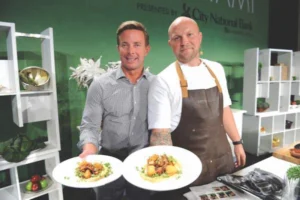
2017 Interactive Dinner celebrity chef and Bravo’s season 13 Top Chef winner Jeremy Ford with City National Bank President & CEO Jorge Gonzalez
The bridge event, dubbed “The Spring Edition,” was successful at maintaining our audience’s interest in VeritageMiami, at least until Hurricane Matthew barreled down on South Florida on the October weekend when we were scheduled to debut the new autumn version of VeritageMiami. Strangely, our effort to move from spring to fall ended up moving the event to winter when, unable to book four consecutive days for a cohesive multi-day festival as had always done before, we were forced to spread the individual events out over three months. The Interactive Dinner with superstar chef (and the season 13 winner of Bravo’s Top Chef) Jeremy Ford moved to January 2017, the Craft Beer Tasting to February and the Fine Wine Tasting at Merrick Park to March. And here we made another change, moving away from yet another dinner for the auction and testing the waters for a less formal brunch event, also held in March.
The takeaway from 2017 was that, despite our trepidation of holding the festival over such a long period instead of consecutive days, it worked out remarkably well. The audience welcomed the opportunity to spread out their attendance and many actually ended up attending more of the events than they did when they were clustered together. And for the VeritageMiami staff it was a much more realistic use of planning time and energy to stage the events on separate weekends. This separated approach is what we’ve followed every year since.
In the next post, I’ll share some of the best recipes from the “chef gangs” mentioned here, and I want to get back to some wine commentary with some BIG news – that is, our “Best in Glass” wine challenge that was staged for the last time in 2017.
Cheers!
Tastings, Cheers and Farewells
Written by VeritageMiami Director Lyn Farmer
As I wind down this series of blog posts tracing the 25-year history of VeritageMiami, I turn to 2016 and 2017 because it was such an unusual period for us. After the 2015 VeritageMiami, we decided to move the festival from our tradition spring staging to the autumn. It seemed a good idea to focus the event near harvest time in the Northern hemisphere and it would also move us away from several wine festivals that had cropped up in South Florida following our early success. When we began in 1996, there were no other festivals to speak of; by 2016 it seemed every charity in the region thought holding a wine and food event was a sure-fire path to success. We also thought an autumn event would let us catch seasonal visitors to South Florida as they were arriving for a winter residency rather than in spring just before they left to return north for the summer. What we didn’t count on was a late-season hurricane, Matthew, that descended on South Florida the October weekend our event was scheduled.
As Matthew barreled down on us, we quickly postponed all the events scheduled for October 5 – 7, 2016 including the Craft Beer Tasting at Wynwood Walls, our Fine Wine Tasting at Merrick Park and the Interactive Dinner on Friday, October 7. Unfortunately, while the hurricane shifted course and passed without doing grave damage to South Florida, we had a hard time rescheduling the events. All venues were booked for the year-end holidays and early in 2017 we couldn’t get three or four consecutive days available at our venues. We ended up scattering the events to dates several weeks apart, only to discover this was not only much easier on our hard-working staff, but the audience appreciated a more spread-out approach as well. What started out as a necessary effort at making up an event turned into a huge success as if we’d planned to stay in springtime all along.
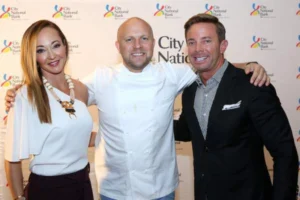
2017 Interactive Dinner celebrity chef and Top Chef season 13 winner Jeremy Ford with VeritageMiami chairs Melinda and Jorge Gonzalez
Jeremy Ford, the recent winner of the Top Chef Season 13 who we had booked for the autumn was fortunately was fortunately available for our new date in the spring of 2017. Jeremy turned out to be a wonderful collaborator who threw himself into the event despite a heavy schedule lingering on from his Top Chef obligations. His appearance marked the start of an ongoing relationship that sees the gregarious chef participating in VeritageMiami nearly every year despite his hectic media-heavy schedule.
Sadly, the rescheduled event in 2017 was the last time we staged our wonderful Fine Wine Tasting at Shops at Merrick Park in Coral Gables. I always loved this tasting because it was reasonably priced and gave both our festival and our audience a wonderful opportunity to have regular connections with the South Florida wine trade. We didn’t charge wineries and distributors to participate and, unlike all the other major festivals in the area, this one was open to all distributors regardless of size. We continue to look at ways to bring the event back to the VeritageMiami roster of events in the future.
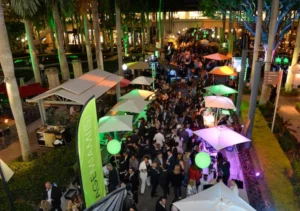
Fine Wine Tasting 2017 at Shops at Merrick Park
Another event to which we bade farewell during this period was the Best in Glass Wine Challenge. Charity events face a challenge – the week or two they take place they are on everyone’s radar, but for 50 weeks a year events struggle for attention and we organizers worry many people forget our events because other current projects are commanding their attention. One way to battle the challenge is to stage mini-events throughout the year to keep one’s name, image and mission in front of people. Best in Glass let us do this in a unique way: it was a sommelier-judged wine competition but rather than invite all the major players to participate, our idea was to only take entries from wines that were priced at a level that would permit them to be featured by-the-glass at area restaurants.
In practice, this meant we only accepted wines that had a wholesale price lower than $20 per bottle. The rule of thumb for by-the-glass wines is that the first glass buys the bottle; in other words, the wholesale price of the bottle is about the retail price of a 5-ounce pour of the wine. We found that many wine companies were intrigued by the concept, especially since sommeliers were judges and their criteria were not based on whether the wine was, say, the best chardonnay they’d ever tasted, but whether it was a wine they could sell with confidence at the price they would need to offer it by the glass. To the public, by-the-glass offerings are a convenience but to wine producers, placement on a by-the-glass list brings considerably enhanced visibility and helps them reach a much-expanded audience.
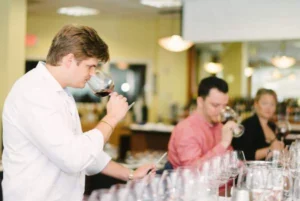
Young Leaders Rush Norton and Ian Beglau, at the time manager of Toro Toro at InterContinental Miami’, together with Jen Schmidt, then head sommelier at Zuma, were among the dozen sommelier-judges at the Seventh Annual Best in Glass Wine Challenge
Best in Glass was held in what was usually our “off season,” with judging taking place in the fall before the sommeliers got busy with their holiday demands. We compiled the results and arranged with our sommelier-judges to each choose two of the group of wines that won a gold medal for by-the-glass placement on their wine lists in the spring, leading up to the first events in VeritageMiami (out of a group of entrants numbering between 250 and 400 individual wines, fewer than 10 percent won a gold medal, but this was still a sizeable pool for the sommeliers to choose from). It was great marketing for the participating restaurants, got wineries coveted by-the-glass placements and gave VeritageMiami a way to get added press coverage just before the main events were held. There was another benefit for us as well – the gold medal-winning wineries each contributed two cases of their medal-winning wines to the festival and we featured the wines at our Interactive and Auction Dinners, further increasing valuable exposure for the wineries while providing the festival dinners with notably sommelier-approved wines. For seven years, it was a win-win for everyone involved but by late 2017 a difficult economy caused a reduction in entrants and in December 2017 we held the final judging for Best in Glass and poured winning wines for the last time at VeritageMiami 2018 when Jeff McGinnis and Janine Booth were our featured chefs.
In my next post I’ll wrap up this history of VeritageMiami, for now at least. There is still history to be created with future festivals, continuing with the final event of VeritageMiami 2021 – our Craft Beer Tasting at Wynwood Walls scheduled for October 28. See you there!
Cheers!

Welcome from Chairs
Dear VeritageMiami friends,
It is our great pleasure to invite you to the 25th year of VeritageMiami. While this year’s events will look a bit different than in past years, don’t worry! We promise the same delicious food, beer, wine and one-of-a-kind experience that you have come to expect from VeritageMiami, all while supporting United Way of Miami-Dade at a critical time.
In our role as Chairs, we are committed to bringing you an entertaining three-day event, where you will have the choice to join us in-person or virtually. In-person events will feature all applicable safety guidelines, including reduced capacities. If you elect to participate virtually, meals and drinks will be provided to you, allowing you to participate remotely, while still being able to reach out and connect with friends.
As we know, this past year has been challenging for all of us, but it has been especially so for the most vulnerable in our community, which is why events like VeritageMiami are so important at this moment. Since its inception, VeritageMiami has raised over $14 million, thanks to you and to all our other sponsors and volunteers. These are funds that support United Way of Miami-Dade’s on-going mission to help children and youth achieve their full potential, promote financial stability, and help people lead healthier lives.
We look forward to having you join us at this year’s VeritageMiami and to continuing to make a difference in the lives of so many in our community.
Cheers!
Drew & Yosbel
Event Chairs, VeritageMiami
Trustees
With the support of trustees, VeritageMiami continues to be one of the most successful charity wine and food events, in one of the largest wine markets in the country. VeritageMiami trustees receive a number of year-round benefits to foster their love of food and wine, all for a greater purpose.
VERITAGEMIAMI 2021 TRUSTEES
Matthew Meehan and Rod Hildebrant
Susan and Bob Norton
Maria C. Alonso and Alex Montague
Sonia and Nestor Plana
Lisa and John Chidsey